If you’ve been researching full arch dental implants, you’ve almost certainly come across All-on-4. It’s widely advertised and well-known — but it’s not the only option, and it may not be the best one for your situation.
At Winterset Dental Care, Dr. Anil Agarwal has been placing full arch implants since 1984. In that time, he’s seen what works long-term and what doesn’t. Here’s an honest look at the difference between All-on-4 and All-on-6 — and how we decide which approach is right for each patient.
What Is a Full Arch Implant?
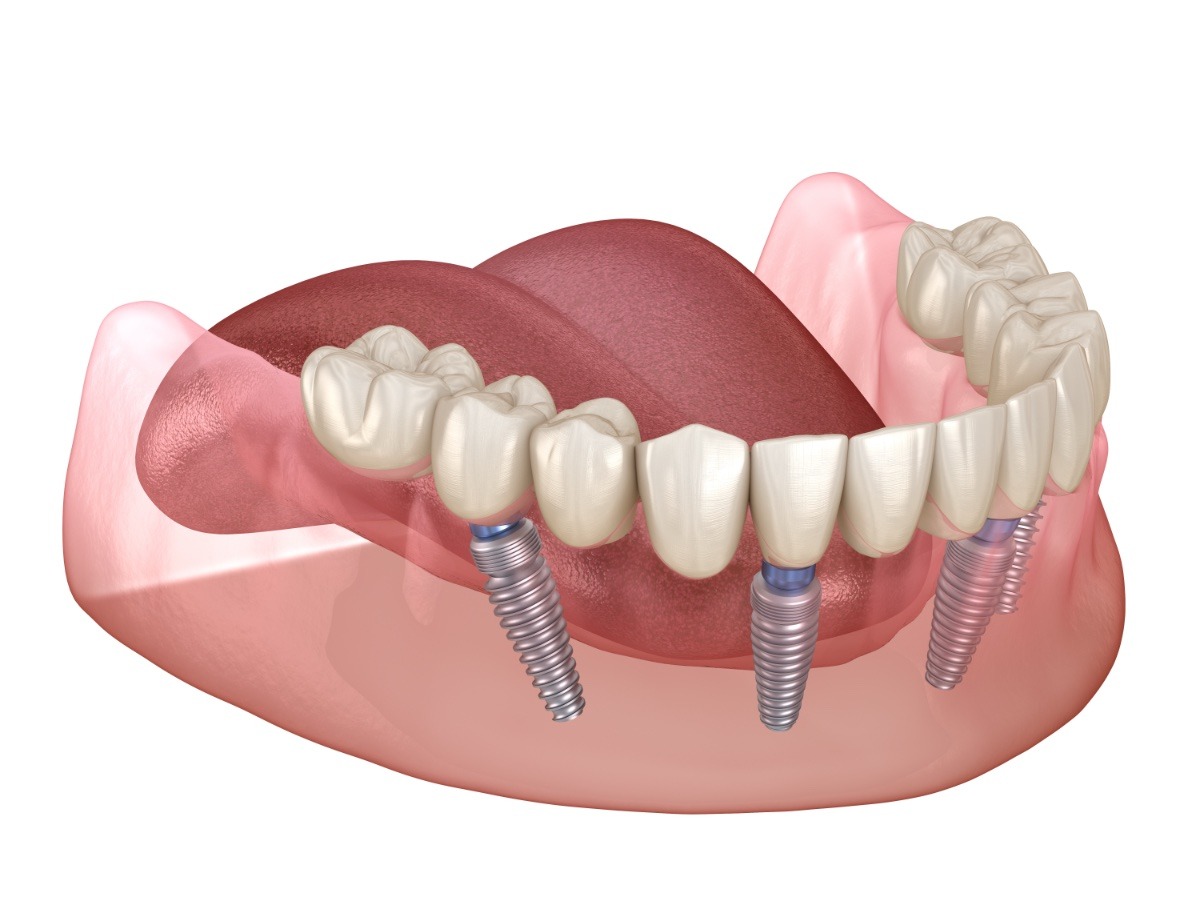
A full arch implant — sometimes called a hybrid bridge or implant-supported fixed bridge — replaces an entire row of teeth with a permanent, non-removable restoration anchored to the jawbone. Unlike traditional dentures, it doesn’t come out at night, doesn’t require adhesive, and functions like natural teeth.
Both All-on-4 and All-on-6 are full arch implant systems. The primary difference is how many implants are used to support the bridge.
What Is All-on-4?
All-on-4 uses four implants per arch to support a full set of teeth. Two implants are placed vertically at the front of the jaw, and two are placed at an angle in the back — the angled placement allows longer implants to be used in areas where bone height is often limited.
All-on-4 was developed in part to reduce the need for bone grafting and to work in patients with moderate bone loss. It’s a legitimate approach, and for some patients, it’s appropriate. However, four implants means four points of support for a restoration that absorbs the full force of biting and chewing — which is worth thinking carefully about.
What Is All-on-6?
All-on-6 uses six implants per arch. The additional implants provide more distribution of bite force across the jaw, greater stability for the final bridge, and a larger margin of safety if any single implant were to be affected over time.
At Winterset Dental Care, Dr. Agarwal typically places six implants per arch — and in some cases five, depending on the patient’s bone structure and anatomy. The goal is always to provide the most stable, longest-lasting foundation possible, not to minimize material costs.
Key Differences Between All-on-4 and All-on-6
Number of support points: Six implants distribute bite forces more evenly than four. The jaw absorbs significant pressure with every meal — more implants means each one bears less individual load.
Bone requirements: All-on-4 was designed to work with less bone by using angled implants. All-on-6 may require adequate bone volume in more areas of the jaw, though bone grafting can address deficiencies where needed. At Winterset, bone grafts are included in our all-inclusive pricing — there’s no extra charge.
Long-term stability: With six implants, the bridge has more anchor points. This can be meaningful for patients who clench or grind, those with heavier bite forces, or anyone planning to have their restoration for decades — which is the goal.
Candidacy: Not every patient is an ideal candidate for six implants, and not every patient needs them. The right number depends on jaw anatomy, bone quality, bite pattern, and the patient’s overall health. This is why a thorough evaluation — including a CT scan — is essential before any treatment plan is finalized.
Dr. Agarwal’s Approach
Dr. Agarwal trained at Northwestern University, where he taught for 21 years and holds fellowships with the American College of Osseointegration and the International Congress of Oral Implantologists, among others. He uses Nobel Biocare implants exclusively — the same system used in the original clinical research on full arch implants.
His approach is straightforward: place enough implants to give patients the most stable, durable result possible. For most patients, that means six. For some, it means five. The number is determined by what the patient’s anatomy and case require, not by what minimizes cost or time.
Every Winterset patient receives a free consultation, exam, panoramic X-ray, and CT scan on their first visit — a $750+ value. That evaluation is what makes an informed treatment plan possible.
What About Nobel Biocare?
Not all implants are the same. Winterset Dental Care uses Nobel Biocare exclusively for all full arch cases. Nobel Biocare is the most studied implant system in the world and carries a 10-year guarantee when placed by a trained provider.
Some implant chains use lower-cost implant systems without disclosing the difference to patients. If you’re comparing quotes for full arch implants, it’s worth asking specifically what implant brand is being used and what clinical research backs it.
Frequently Asked Questions
Is All-on-6 better than All-on-4?
For many patients, yes — more implants provide more stability and better long-term support for the restoration. That said, “better” depends on the individual patient’s anatomy, bone quality, and clinical situation. The right number of implants should be determined after a thorough evaluation, not before it.
Who is a candidate for All-on-6?
Most adults with failing, missing, or severely damaged teeth who are in reasonably good general health are potential candidates for full arch implants. Adequate bone volume is important, though bone grafting can address deficiencies in many cases. A CT scan is the best way to assess candidacy accurately.
How much does All-on-6 cost compared to All-on-4?
The cost of full arch implants depends on the number of implants placed, the materials used, and what’s included in the treatment package. At Winterset Dental Care, our full arch pricing is all-inclusive — surgery, implants, temporary bridge, final bridge, night guard, and one year of maintenance — with no hidden fees. Contact us to discuss your specific case and get accurate pricing for your situation.
Does Winterset Dental offer All-on-4?
We offer full arch implant solutions tailored to each patient’s needs, which may include four, five, or six implants depending on the case. Our default approach uses six implants for the stability and longevity benefits they provide, but every treatment plan begins with a thorough evaluation of your specific situation.
Ready to Find Out Which Option Is Right for You?
The best way to know whether All-on-6, All-on-4, or another approach is right for your case is to sit down with a specialist who can evaluate your jaw, your bone, and your goals.
Dr. Agarwal and the team at Winterset Dental Care offer a free first visit — including a full exam, panoramic X-ray, and CT scan — so you can get real answers before making any decisions.
Schedule your free consultation at our Chicago or Orland Park location, or call us at 773-582-0035.